Saturday, 6 March 2021

The 'SCARECROW' AS A METAPHOR                                                                                                                                                                                          (this project is partially funded by National Arts Council

The ARROWSA - INDRA, South to North and SAUKINDIA  collaboration moved from scarecrows as literal artworks to considering them as metaphors for addressing social ills including gender based violence.  

In one of our arts for social change sessions South Roots International participants shared their interpretations of the scarecrow. Below are the script drafts and photographs of their presentations in the session.

Angela del Fava:


Hi everyone. For anyone who is new that is tuning in my name is Angela Del Fava and I come from a community in Durban South Africa called Sydenham. When I think of my community amidst it's beauty, I see gangsters, drug dealers, beggars, inequality and poverty. And so, in relation to our topic of gender-based violence and our scarecrow project, I decided to tell a different story about the men in my community. So, sit back, relax and enjoy.


Show cartoon drawings with music.

So moral of the story, the good you stand for, male or female, shines light and creates an impact. Not just for now but for generations to come. The backpack of my scarecrow is unity, identity and community development. I believe this is what my community needs right now. This is what my scarecrow believes in and that he chooses to carry with him.

Thank you!


Noluthando Shandu:


A scarecrow that scares away all the inequalities and social issues in South Africa using the gifts and strengths of the people groups in SA.

Legs represent the Khoisan speaking people. They are the first people of the land, they live closely with the land. They steward and cultivate the land. 

Stomach represents the Coloured people. They are people of hospitality! Coloured aunties feed you lekker! The buttons on the stomach represent the diverse bloodlines they carry, a physical representation of Ubuntu.

The arms represent the Bantu speaking people. They are warrior people, fueled with confidence and a spirit of conquering, community orientated people.

The neck represents the Afrikaans speaking people. People with tenacity, steadfastness and Bly Staan spirit.

The mouth represents the people of Indian descent. They are people who are very good with business, bring pizazz, shine and spice into the nation.

The eyes are the English speaking people. They are visionary people that pay close attention to detail, compassionate and have great communication skills.

Ngiyabonga. Gangangs. Dankie. Thankyou.


Rachelle Mukendi:


Jesse Jack:


My script...


Good day Indra family, my name is Jesse and  I would like to share my scarecrow with you.


The scarecrow's name is 'the protector' and I use this name for the following reasons I will be mentioning. In my community there is a lot of garbage and litter around beautiful trees, flowers and reeds on the riverbank. In time, nature grows and in twine with the litter and they are now fused together because of the lack of stewardship of the people that is walking around it and not picking it up.


Now, my scarecrow protects not just the nature but man-made things to. See, in order to make glass you'll need sand to do so and in order to make paper you'll need trees to do so. In other words, they are all one in the same and the protector does  show it that quite well as you can see here (showing parts of the scarecrow).


That is it from me and my scarecrow, Thank you!

Gracia Nicholls and Nicole Sacco:

Scarecrow script - Brilliant Black Beauty

Both: This is Brilliant Black Beauty

Gracia: She is made up of old plastic, toilet rolls, come plants and old fabric.

Nicole: She represents every indigenous woman and every woman in South Africa and Africa.

Gracia: She also represents every woman who has risen up, embraces her identity and fights against the evils in society.

Nicole: She is redeemed, powerful, royalty, she is Brilliant Black Beauty. She is resilient, humble and she is radiant!


Selby Williams and  Sue-Livia van Wyk

 Scarecrow SCRIPT 

(This scarecrow is twofold - depicting the actual scarecrow in the garden but also taking on his role as protector of women and girls. Protecting them from the evil of the world - gender based violence. Knowing and understanding his role as a man)

(The flower represents women and girls in society that have been effected by gender-based-violence)

Scarecrow: I am a descendant of the first people of the land that are known as the stewards of the land. Looking after the crops and the fields. Protecting them from those who come to steal and devour. 

Flower: Oh get away from me! You're like all of them... you take and take and take as if it belongs to you!  Get away, just get away! Stop taking what's not yours!

Scarecrow (responds to Flower in a song):

I am Here for you
Ngizokunakekela
So do not be afraid
'Cause each and everyday
I am here to stay (2x)

Every season
Summer, Winter,
Autumn, Spring
Winds and rains
Everything coming your way (x2)

Mbali Umhle
You are strong
You're a warrior
So much more (x2)

Flower (believes Scarecrow and sings back in response - they then sing together - believing that she is beautiful and worthy to be loved!


Ntombi Khena:


 Shanette Martin:

Presentation of who I am?


I think not it be necessary as you see. Authority and strength

Wisdom at length

Protecting to be what must be.

Protection for whom do I hold this fort? Birds that must fly, bees to draw nigh, but turn me around and it will be found This image of God cannot be bought.

Protectors who will stand - fathers, brothers, husbands’ friends without compromise.


Protection of why we were born - our purpose and destiny.


If we look at the reflection of ourselves or others and know that we are created in God’s image, we will not dare allow the violation of trafficking, violence or any other abuse.


Blue & White - UK but also peace and love 

Practical reflectors, ribbons, cloak and a bell to shoo the birds.

SA Flag - Safety for all our people in our land


Thursday, 25 February 2021

Gendered representations in museums: examples from South Africa 


Presented by Ayanda Ngcobo (Museum officer, Bergtheil Museum, eThekwini Local History Museums, Durban South Africa) on 12/02/2021.

ARROWSA - Indra workshop as part of the South to North and SAUKINDIA projects including youth from South Africa, India and United Kingdom 


One of a series of workshops partially funded by National Arts Council, SA. 

Blog post written by Luyanda Makoba-Hadebe 


 "Most people have little or no say in the depiction of their own history in textbook, libraries and research institutions[museums]. The meaning portrayed about Africans is painful to recall. Our museums represented the kind of heritage which glorified whites' activities and colonial history." – Nelson Mandela, 1997. 


The world health organisation defines gender as a socially constructed characteristic that defines women, men, girls, and boys (WHO,2021). The impact that gender has goes beyond the social parameters that impact one personally—gender impacts who gets seen and how they are represented in history. Ayanda Ngcobo, a master's student and a Museum officer at Bergtheil Museum in Westville, Durban work revolves around women's representation in museums. Ayanda believes that "Museums represented the power holders, their concepts of museology, of public commemoration and society." (Ngcobo,2018). 


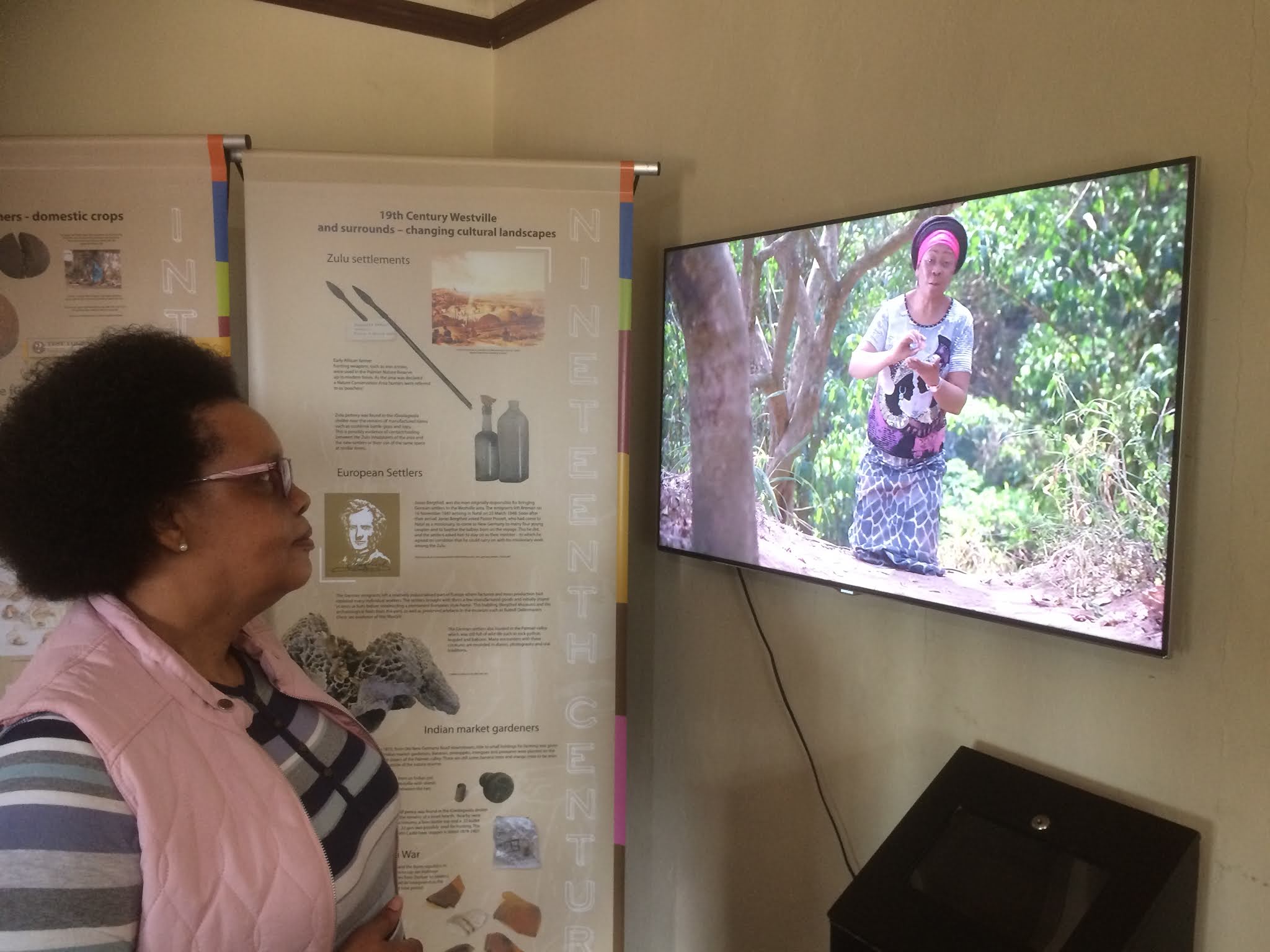
Valencia Gushu of Bergtheil Museum, LHM, Durban watches storyteller Dr Gcina Mhlope use storytelling to describe the cultural heritage of the iGwalagwala Cliff archaeological site.


She conducted a skills transference workshop for ARROWSA that gave great insight into how gender impacts how museums. Museums, in South Africa were first established in 1800's. The colonial government of the time curated museums to represent the ideologies that they believed in. Ayanda Ngcobo elaborated on how museums had become a political space during South Africa's apartheid years. 


Voortrekker monument Pretoria

When the political hold of the government started to weaken in the 1980's, questions started to arise about how museums could be more inclusive by The South Africa Museums Association. In 1994 when South Africa became a democratic country, the African National Congress won the election and advocated for racial equality. The government created a new constitution, new policies focusing on the reconstruction of the country. Their main themes were reconciliation and nation building and wanted to impact the cultural landscape. During this time of reconciliation, the government was worked on changing how the country was represented. Efforts have been made with a focus on what dominates the cultural and heritage sector. This included statues of new heroes, like Nelson Mandela, erected alongside white European men's old statues. The statues that were being erected were predominately men. 


   King Dingane, Ncome Museum

Museums and tourism were a field under the apartheid government that Africans were not privy to. After 1994 museums were being opened in townships to represent new heroes and neglected histories. Some women activists in their own right, women like Bertha Mkhize, Charlotte Maxeke have not received the same recognition as their male counterparts. New national heroes were to be identified, the women took a back seat. When women were shown, they were usually shown as: 


 • Domestic related items 

 • Communal 

 • Auxiliary workers 


This brings about questions about how women are represented through one socially constructed domestic lens. Women are seen as the subject and not the main object in museum displays, showing how gender filters into how gender is represented. Ayanda closed her workshop with three questions: 


1. How would women want their stories to be narrated?  

2. What representations would be gender-balanced? 

3. When you think of museums around you, what have you noticed about representations of history and gender?


CCMS, UKZN Signs Community Engagement Agreement with ARROWSA


Read the article at UKZN Ndabaonline


https://ndabaonline.ukzn.ac.za/UkzndabaStory/Vol9-Issue3/CCMS%20Signs%20Community%20Engagement%20Agreement%20with%20ARROWSA


Together here are (from left) ARROWSA chair Dr Mary Lange and Mr Bheki Dlamini of ARROWSA Bechet with UKZN’s Professor Ruth Teer-Tomaselli and Professor Lauren Dyll.


Thursday, 21 January 2021

ARROWSA-INDRA South to North collaborative arts for social change project        (partially funded by National Arts Council South Africa) 15th Jan 2021

SCARECROWS

South Roots International led the 'Scarecrow' session with Shanette Martin introducing her  perceptions of Scarecrows and introducing the history of their origins. Nicole Sacco encouraged the participants to create their own scarecrows out of any materials that they had at hand in their homes and to plant a/some vegetables whether in a pot for the windowsill or in a patch of land. Angela Del Fava then led a visualisation session to encourage the participants to identify their own context that would influence the construction of their artistic scarecrow that would be unique to their cultural and physical context. The success of the exercise was evident in the responses of the participants. 


Sue-Livia van Wyk and her team shared a fun interactive Scarecrow song and dance that they devised. 


We look forward to seeing the unique scarecrows that the participants create!

ARROWSA-INDRA collaborative projects 2020-2021 - planning

(these projects are partly funded by the National Arts Council South Africa)

South to North project team: ARROWSA Bechet, South Roots International, Gorse Hill Studios Manchester and Touchstones Rochdale Indra United Kingdom.

SAUKINDIA project team: ARROWSA, South Roots International, Study Hall Education Foundation Lucknow India, Bergtheil Museum  Durban, CCMS, University of KwaZulu-Natal and Touchstones Indra Rochdale United Kingdom

Planning for the year

ARROWSA joined their South African and international Indra partners to plan a series of skills transference workshops and arts for social change sessions for the first quarter of 2021. It was decided to overlap the South to North and SAUKINDIA projects as time differences would allow as they would both  focus on gender based violence and cultural and male identity.


Bheki Dlamini of ARROWSA Bechet reflects on the importance of the Climate Change project.


Bheki Dlamini of ARROWSA Bechet speaks of the way forward and the focus on gender based violence


Arunima Trivedi of Study Hall Foundation Education Foundation (SHEF) confirms collaboration


.